Transparent Leadership.
The Parliament of Jamaica is the nation’s law-making body responsible for creating laws, representing citizens, and overseeing the Government.
About Us
The Parliament of Jamaica is the highest law-making institution in the country and serves as a key pillar of Jamaica’s democracy. Established in 1664, it is one of the oldest parliamentary systems in the Caribbean. Parliament is responsible for creating laws, representing the people, debating national issues, approving government spending, and ensuring accountability within the Government.
It consists of two Houses
- the Senate and
- the House of Representatives
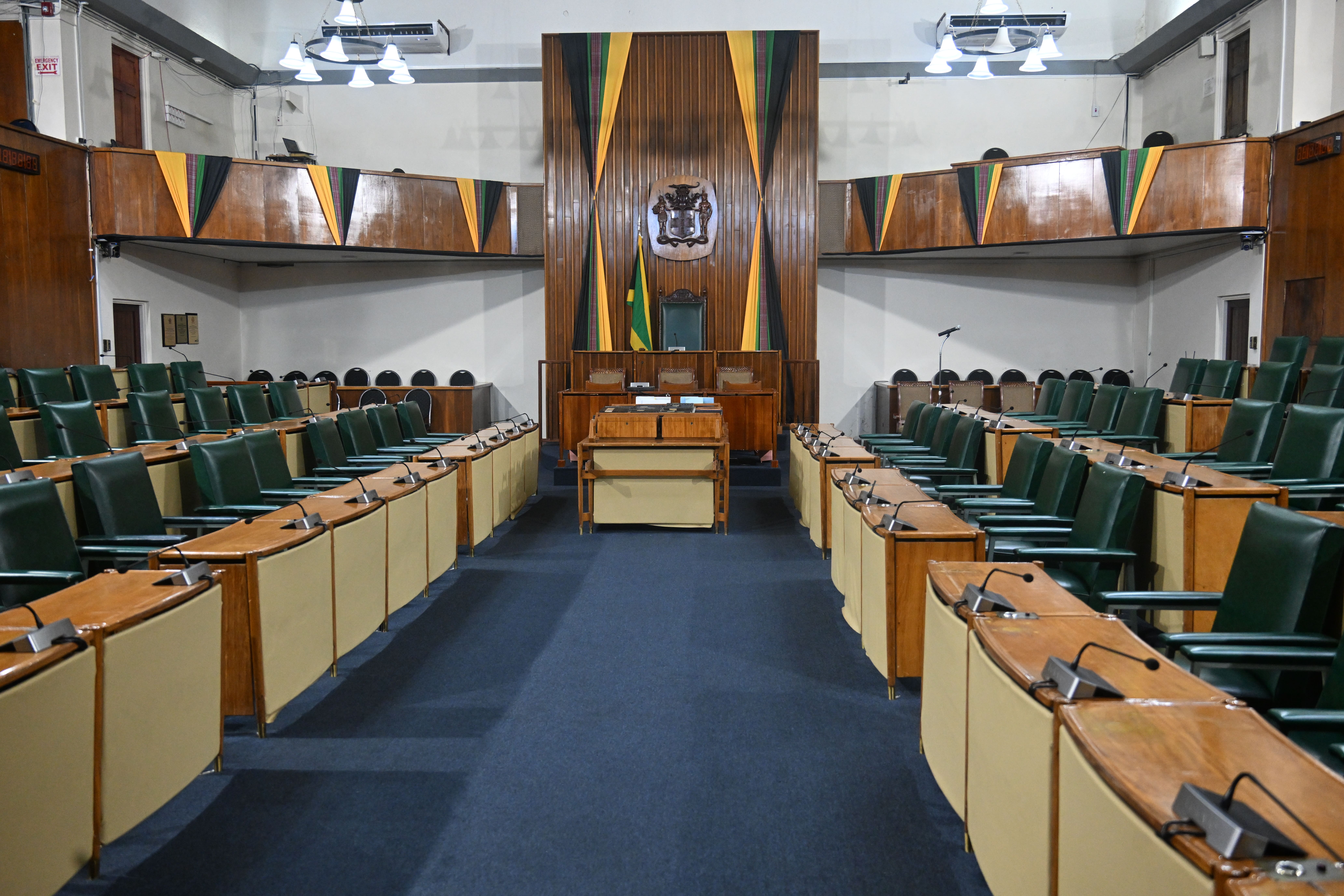
that meets at Gordon House in Kingston, the official seat of Jamaica’s Legislature since 1960. Through its work, Parliament promotes democratic governance, national development, and the protection of citizens’ rights and interests.
Our Mission
Supporting our democracy by facilitating the work of our Parliamentarians and creating a citizenry which is informed and interested in the work of the Legislature
Our Vision
To be a recognized leader of parliamentary best practices, efficiency and operational effectiveness, enabling us to meet the aspirations of the Jamaican people.
Timeline of Jamaica's Legislature
1664–1744
Foundation of Representative Government
The history of Jamaica’s Legislature began on 20 January 1664, when the first House of Assembly met in St. Jago de la Vega, now known as Spanish Town. This marked the establishment of representative government in Jamaica under British colonial rule. The exact location of this historic first meeting remains unknown, but historians believe it may have taken place in the Governor’s residence, the local Court House, or the Cathedral, which was later known to host Assembly meetings. During this period, there was no permanent legislative chamber, and government officials often used available public and religious buildings to conduct official business.
1744–1762
Creation of a Permanent Legislative Home
As the responsibilities of government expanded, the need for a dedicated legislative building became increasingly apparent. On 9 June 1744, the House of Assembly passed legislation authorizing the construction of a purpose-built facility for the Assembly, Council, and the preservation of public records. Construction likely began around 1749–1750 after land was acquired and existing structures were cleared from the site. By 1752, substantial funds had already been invested in the project. The Assembly first occupied the building in 1759, and the structure was fully completed in 1762. The impressive edifice contained an Assembly Chamber, Speaker’s Room, Court House, Jury Room, and several government offices, becoming the centre of legislative activity in Jamaica for many years.
1755
The Kingston Interlude
Although Spanish Town remained the principal seat of government, the Assembly temporarily met in Kingston in 1755 during the administration of Admiral Charles Knowles. Historical records suggest that meetings may have been held in several locations, including the Kingston Court House, Wolmer’s School, or private residences. One documented session was adjourned to the home of merchant and Assembly member Thomas Hibbert to allow legislative business to continue while two members were ill. While brief, this period highlighted Kingston’s growing significance as an economic and administrative centre.
1872–1960
The Hibbert House Era
A major chapter in Jamaica’s parliamentary history began when Hibbert House, one of the island’s finest examples of eighteenth-century Georgian architecture, became the seat of the Legislature. Originally built by wealthy merchant Thomas Hibbert, the house was later purchased by the War Office in 1814 and became known as Headquarters House. In 1872, the Government acquired the property for £5,000 and established it as the home of the Legislature. For nearly ninety years, Hibbert House served as the centre of Jamaica’s parliamentary activities and witnessed many important constitutional developments during the island’s journey toward modern self-government.
1960–Present
Gordon House: Home of Modern Parliament
In 1960, Jamaica’s Legislature moved to a newly constructed parliamentary building in Kingston known as Gordon House. The building was named in honour of George William Gordon, the Jamaican patriot and Assemblyman who was executed following the Morant Bay Rebellion of 1865. Since its opening, Gordon House has served as the permanent home of Jamaica’s Parliament, housing both the Senate and the House of Representatives. Today, it remains the centre of the nation’s democratic process, where laws are debated and enacted, national issues are discussed, and the work of Parliament continues on behalf of the Jamaican people.
Civic Files Access
Public Documents and Resources
The National Legistaltive Repository (NLR) is the country’s premier repository of Jamaica’s documented heritage and historical information. Established to preserve and provide access to Jamaica’s cultural, educational, and historical records, students, and the wider public through its collections, archives, publications, and digital resources. The NLR plays an important role in safeguarding the nation’s memory while promoting literacy, research, and lifelong learning for all Jamaicans.